
Why Florida shortens every lifespan number
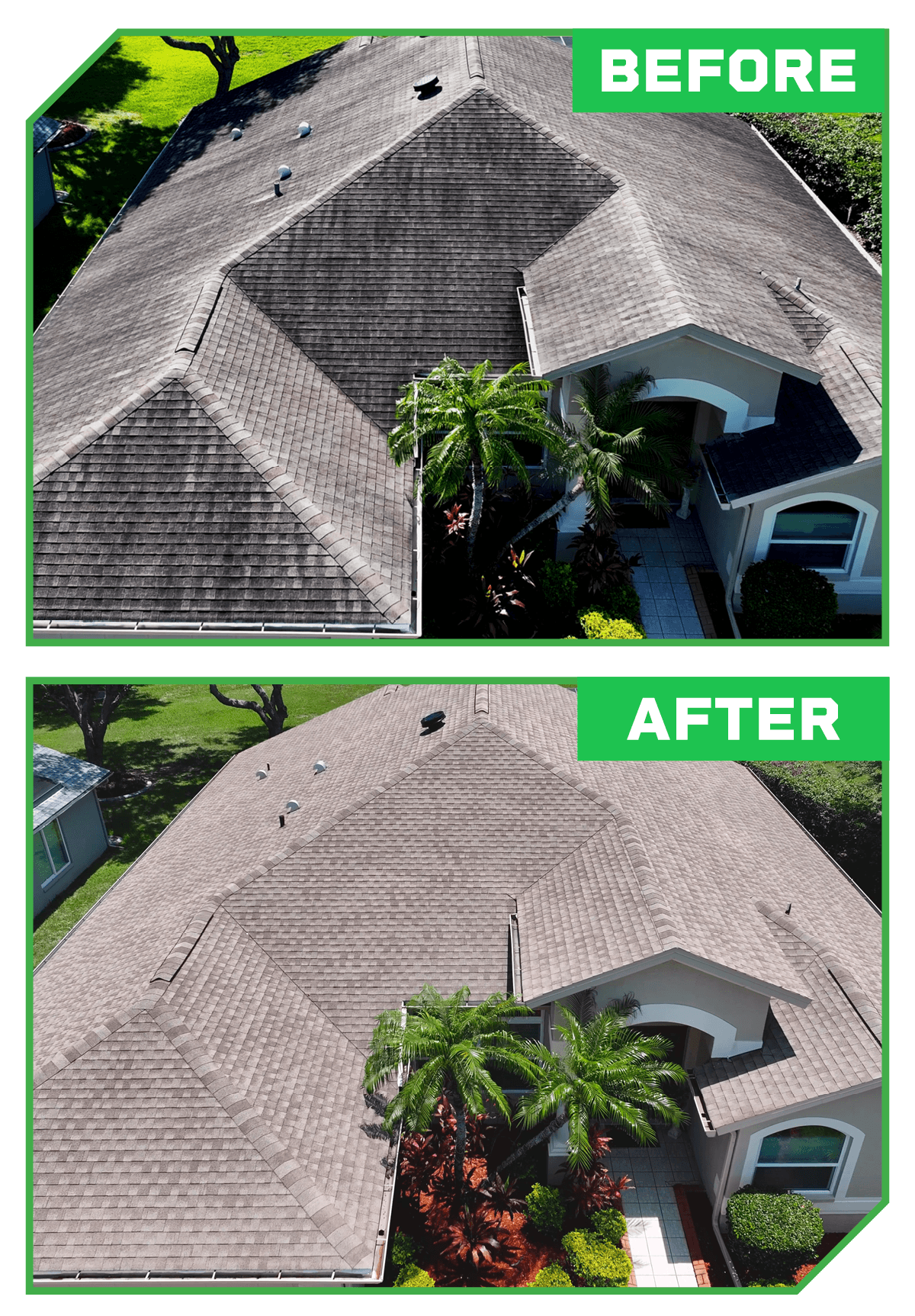
Shingle packaging is written for the national average. Florida is not the national average. Year-round UV exposure bakes the oils out of asphalt binder faster; daily heat-cool cycling flexes the shingles thousands of extra times; coastal salt air corrodes fasteners and flashings; hurricane-season wind works at every edge; and Gloeocapsa magma algae colonizes the surface. A shingle rated for 30 years in Ohio is doing well to deliver 20 in Tampa.
Realistic Florida lifespans by material
| Material | Manufacturer marketing | Realistic Florida range | What usually ends it |
|---|---|---|---|
| 3-tab asphalt shingle | 20–25 years | 12–15 years | Brittleness, blow-offs, granule loss |
| Architectural asphalt shingle | 25–30+ years | 15–20 years | Binder dry-out, curling, insurance age limits |
| Metal (standing seam) | 40–70 years | 30–50 years | Fastener/sealant failure, coastal corrosion |
| Concrete/clay tile | 50+ years | 30–50 years | Underlayment failure (the tiles outlive the felt) |
| Flat/modified bitumen | 15–25 years | 10–20 years | Ponding water, membrane cracking |
Two notes worth internalizing. First, on tile roofs it is usually the underlayment — not the tile — that fails, which is why "50-year tile roofs" get torn off at year 30. Second, for asphalt the range is wide because maintenance moves the needle: a cleaned, maintained, and rejuvenated architectural roof behaves very differently at year 15 than a neglected one.
Condition beats age: the signs that actually matter
- Granule loss — bald patches or heavy granule wash-out in gutters means the wear layer is going
- Curling and clawing corners — the binder has dried out and the shingle is shrinking
- Cracked or brittle shingles that snap instead of flex when lifted gently
- Multiple unrelated leaks — one leak is a repair; three is a pattern
- Soft decking underfoot or attic-side water staining — structural, act now
- Widespread wind damage after storms — shingles that no longer reseal
Age alone should never trigger a replacement. A 16-year-old roof with none of these signs has life left — potentially a lot of it. A 10-year-old roof with soft decking needs attention immediately.
The insurance clock runs faster than the roof clock
In Florida the practical answer to "how often do I replace my roof" is often set by underwriting, not physics. Many carriers tighten terms or threaten non-renewal as asphalt roofs pass roughly 15 years, regardless of actual condition. That gap — a roof with years of real life left and a carrier that only sees the age — is exactly where documentation earns its keep: a professional inspection with a Certified Life Letter documents remaining useful life in a form carriers review. Florida law also requires advance written notice before non-renewal, which gives you a window to act. We cover the play-by-play in our insurance non-renewal survival guide.
Florida legislation in recent years has also softened the old repair-versus-replace rules for roofs built to modern code — meaning partial repair is allowed in more situations than many roofers quote. If a contractor tells you a small repair legally forces a full replacement, get a second opinion before signing anything.
Replace, or buy more years?
When an asphalt roof is aging but structurally sound — roughly the 6-to-20-year window — you usually have a choice the replacement quote does not mention: rejuvenation restores the dried-out binder and adds 5-15 years for a small fraction of replacement cost. Run your own numbers with our roof replacement cost calculator, then read the full breakdown of every alternative to replacement. When the roof has structural failure, widespread bald spots, or a dead underlayment, replacement is the honest answer — and doing it on your schedule beats doing it on your insurer’s.
Frequently asked questions
How often should a roof be replaced in Florida?
Asphalt shingle roofs typically need replacement every 15-20 years in Florida (12-15 for 3-tab), metal every 30-50, and tile every 30-50 driven by underlayment. Condition and insurance requirements usually decide the actual date, not the calendar.
Can a Florida roof last 25 years?
An architectural asphalt roof that is well-ventilated, kept clean of algae and debris, and rejuvenated once or twice in mid-life can plausibly reach 25 years. A neglected one in full sun rarely does. Metal and tile routinely exceed 25.
Will insurance make me replace my roof at 15 years?
Some carriers tighten at around 15 years for asphalt, but most will review documentation of actual condition. A professional inspection and a Certified Life Letter documenting remaining useful life has kept many Florida policies in force past that mark.
Is it better to replace before the roof fails?
Yes — a planned replacement on your schedule beats an emergency one after a leak ruins drywall and flooring. But "before it fails" is not "at an arbitrary age." Get the condition assessed, extend what can be extended, and replace when the roof — not the calendar — says so.
Free on-roof inspection anywhere in Tampa Bay. We tell you the honest condition, whether rejuvenation can buy you years, and when replacement really is the right call.